
We pulled the same 4,996 LinkedIn URLs through Lusha and ZoomInfo, then ran ZoomInfo’s free waterfall enrichment on top to see what a 25-vendor stack adds. Lusha’s single source beat ZoomInfo’s native data on every filter. Against the full waterfall, Lusha still won on mobile phone and stayed within 5 points on overall reachability, while ZoomInfo pulled ahead on work email.
What we tested
The test set was 4,996 distinct LinkedIn URLs, sampled from recent searches by paid users, pulled on weekdays only, capped at 10 searches per account, and uploaded to GTM Studio in ten batches. ZoomInfo’s data was pulled on July 9, 2026. Lusha’s was pulled a week later, on July 16, 2026.
On top of ZoomInfo’s native result, we layered a free waterfall enrichment ZoomInfo runs across 25 or more additional vendors. We then measured hit rate: given a list of LinkedIn URLs, the share that came back with a verified work email or mobile phone. That’s a stricter bar than ZoomInfo’s own match rate, which just checks whether a record exists for the URL, phone or email or neither. On this test set, match rate was 78.8 percent, 3,938 of 4,996 URLs. Hit rate is what follows once you ask whether that record actually resolved to something a rep can use.
The waterfall’s biggest lift is work email
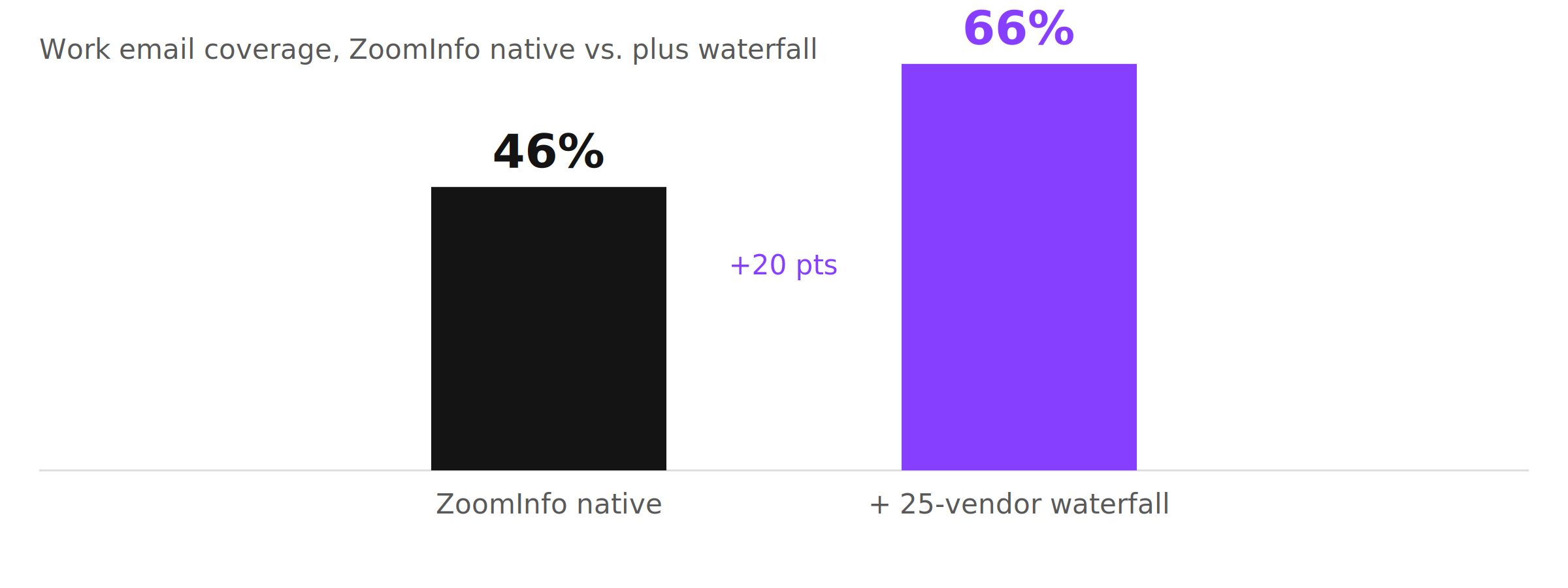
ZoomInfo’s native data returned a work email for 2,290 of the 4,996 contacts, 46 percent. Adding the 25-vendor waterfall brought that to 3,318 contacts, 66 percent, a 20-point jump. Email is where a layered waterfall earns its keep.
Lusha vs. ZoomInfo’s native data
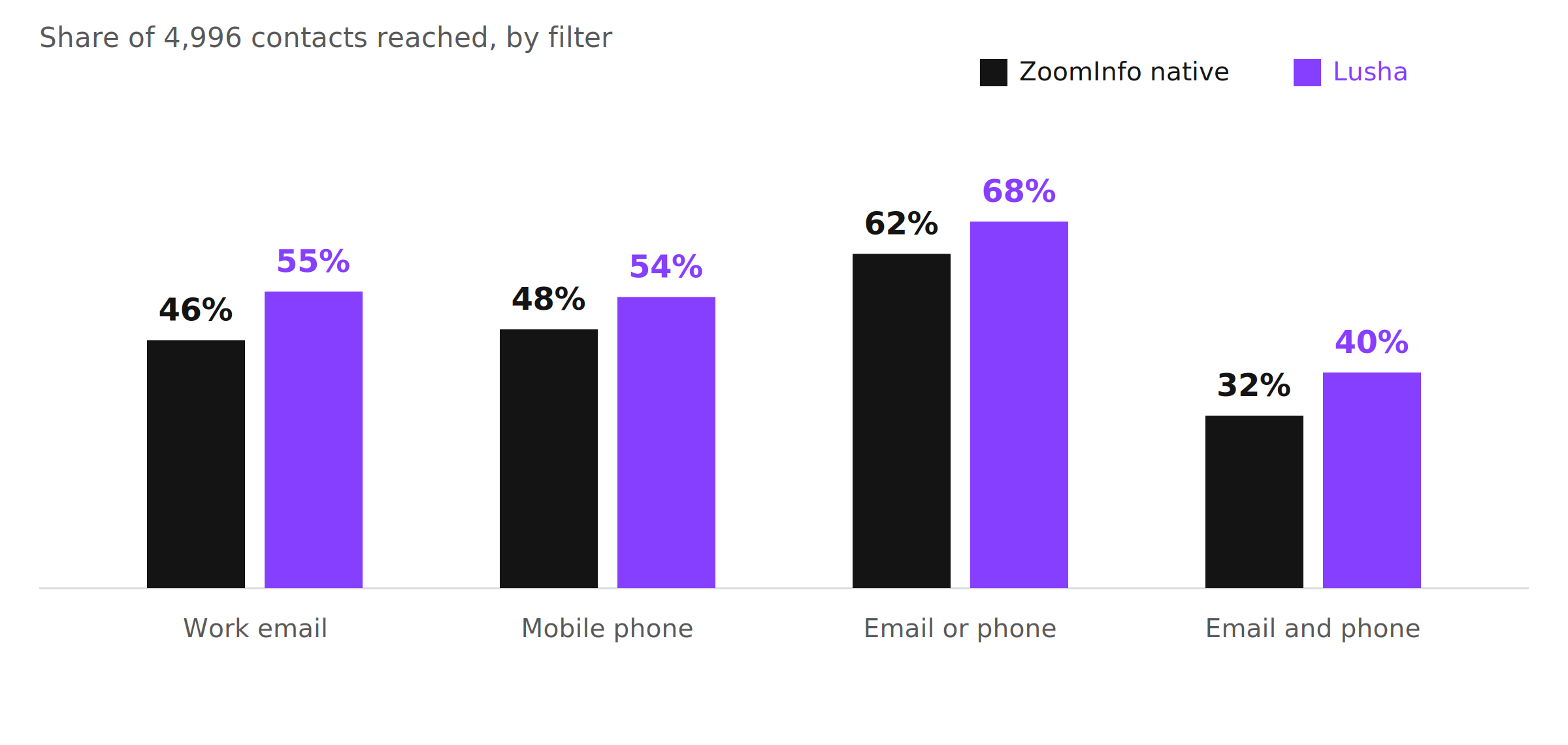
Before ZoomInfo runs any waterfall, a single Lusha pull already leads on every filter in the test.
| Filter | ZoomInfo native | Lusha | Difference |
|---|---|---|---|
| Work email | 46% | 55% | +9 pts |
| Mobile phone | 48% | 54% | +5 pts |
| Email or phone | 62% | 68% | +6 pts |
| Email and phone | 32% | 40% | +9 pts |
The gap holds across every column, work email, mobile phone, either, and both. Lusha isn’t ahead on one filter and behind on the rest, the lead is consistent.
Lusha vs. ZoomInfo’s native data plus the waterfall
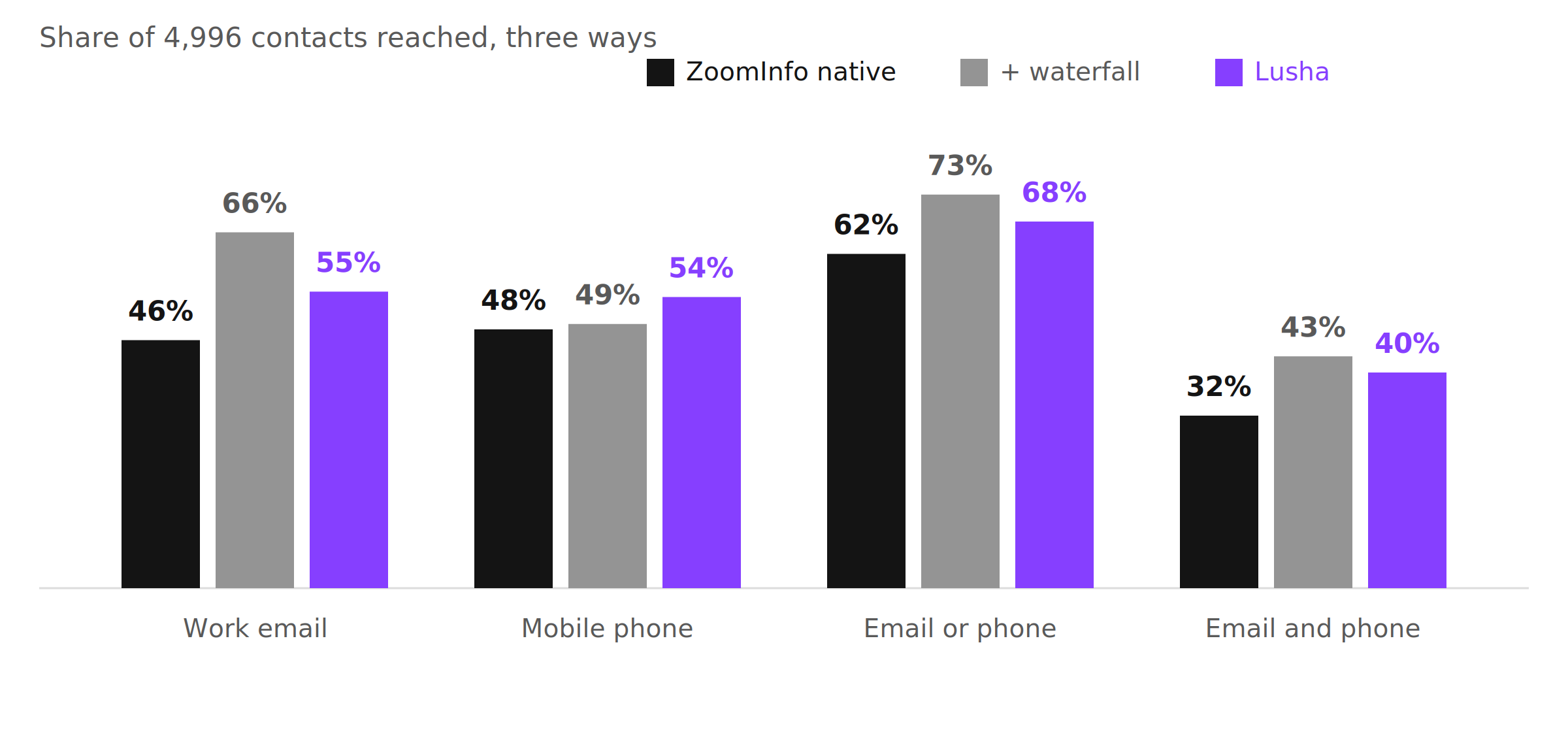
Add the 25-vendor waterfall and the picture changes on two filters and holds on a third.
| Filter | ZoomInfo native | ZoomInfo + waterfall | Lusha |
|---|---|---|---|
| Work email | 46% | 66% | 55% |
| Mobile phone | 48% | 49% | 54% |
| Email or phone | 62% | 73% | 68% |
| Email and phone | 32% | 43% | 40% |
Three things stand out here.
- On work email, the waterfall pulls ZoomInfo ahead of a single Lusha source, 66 percent against 55 percent.
- On mobile phone, the waterfall barely moves the number, 48 percent to 49 percent, one point, while Lusha reaches 54 percent from one source. Twenty-five vendors added less to phone coverage than Lusha gets from its own data.
- On overall reachability, email or phone, ZoomInfo plus the waterfall reaches 73 percent against Lusha’s 68 percent, a 5-point gap. Close enough that a single source is doing most of the work a 25-vendor stack does.
What a single pull actually looks like
Numbers on a chart are one thing. Here’s what two of those hits looked like when we ran them, pulled live from Lusha and masked for this post.
| Contact | Title | Company | Work email | Mobile |
|---|---|---|---|---|
| Zac H. | VP of Sales | Verkada | z.h****@verkada.com | +1 516-606-**** |
| Michael B. | VP of Enterprise Sales | Verkada | m.b****@verkada.com | +1 773-251-**** |
Both came back on a single search, work email and mobile phone together, the “email and phone” column in the tables above. That’s the case where one contact record clears the highest bar in the test.
One honest note from the same pull. A third contact at Verkada came back with a title that didn’t match between search and enrich, a director-level role in the search result, a founder-level role once enriched, with the previous title showing up in employment history. Work email and mobile phone were both correct and current. Title fields update on a different cycle than contact fields, so a role that looks stale is worth a quick LinkedIn check before it’s worth a discard.
What this means for a GTM team choosing a data source
If the job is filling a CRM field with any work email, ZoomInfo’s waterfall adds real coverage, 20 points of it. If the job is reaching someone by phone, one Lusha source outperforms a 25-vendor stack, and a waterfall that size usually comes with a cost or a workflow step ZoomInfo’s native product alone doesn’t have.
For a rep building a list that needs to convert to a real conversation, not just a CRM field, the mobile phone number is often the number that matters most. That’s the filter where a single Lusha source does something a 25-vendor waterfall can’t match.
Methodology notes and definitions
- Phone number definition. ZoomInfo counts mobile numbers only, not direct dials. Lusha counts mobile and other phone types. In practice the two are close, 94 percent of Lusha records with any phone number also carry a mobile number, so the definitions diverge on roughly 6 percent of records.
- Data freshness. The two sources weren’t pulled on the same day. ZoomInfo was pulled July 9, 2026, Lusha on July 16, 2026.
- Match rate vs. hit rate. Match rate is ZoomInfo’s own metric, whether any record exists for a URL, with or without contact details. Hit rate, the metric used throughout this post, is stricter: whether that record includes a usable work email or phone number.
- Test set. 4,996 distinct LinkedIn URLs from recent searches by paid users, pulled on weekdays only, capped at 10 searches per account.
Images and examples on this page are for illustrative purposes only. The contact shown is real, pulled live from Lusha, with the last name abbreviated and email and phone partially masked for privacy.