Part of Lusha’s ongoing measurement of B2B data decay. Every finding in one place: How fast B2B contact data decays. Lusha B2B Contact Change Report, Q2 2026. 1,470,414 company changes measured.
TL;DR
- What it is: Lusha’s Q2 2026 B2B Contact Change Report tracks company changes and promotions detected in Lusha’s live signal database between January 1 and June 1, 2026, across 515M+ verified contacts.
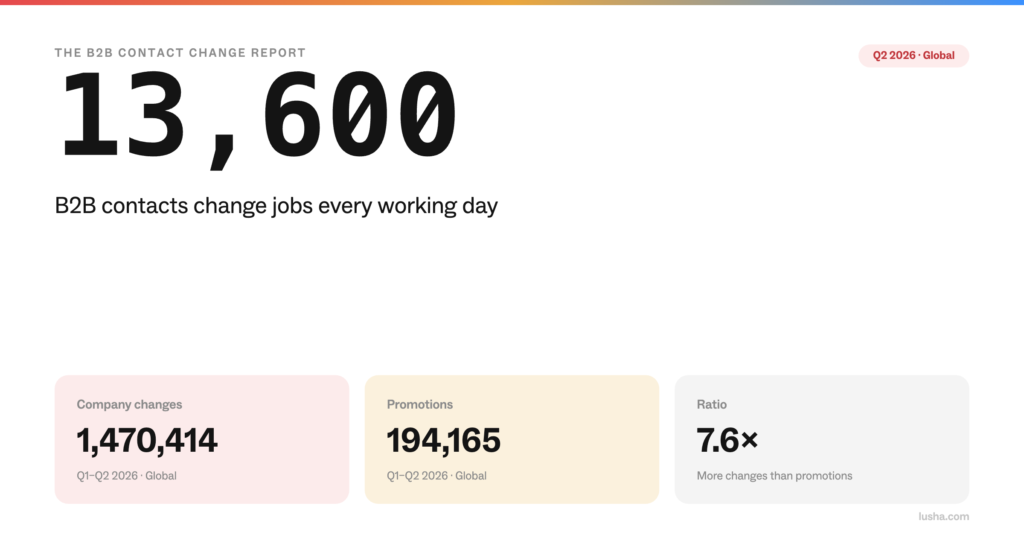
- The headline numbers: 1,470,414 contacts changed companies and 194,165 were promoted in the window, an average of 13,600 company changes per working day, and a 7.6:1 ratio of company changes to promotions.
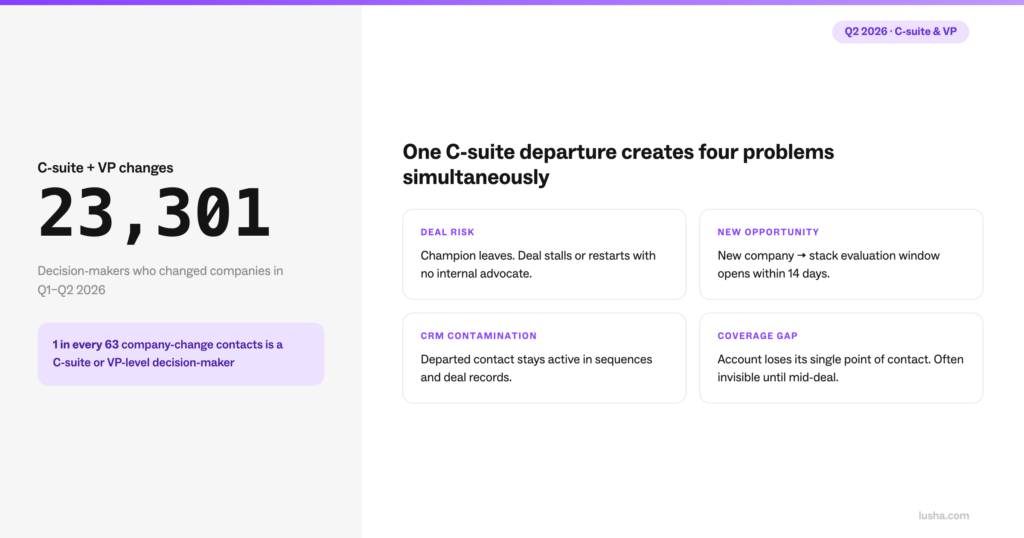
- Who is moving fastest: Sales is the busiest function at 121,238 company changes, followed by IT at 60,384. C suite and VP level contacts saw 23,301 changes, 1.6% of the total and the segment with the largest consequences.
- What to do: validate active deal contacts monthly, territory contacts quarterly, and campaign lists before every send. The cadence figures below use our measured decay rate of 12.6% a year, about 1% a month, not the 30% annual figure this category repeats without a source.
Published: June 2026. Updated: September 2026.
Data source: Lusha live signal database, 515M+ verified contacts, signals pulled June 1, 2026.
Signal window: January 1 to June 1, 2026.
Methodology note: signal counts reflect contacts with a detected company change or promotion event during the reporting window. Department and seniority breakdowns use Lusha contact classifications. Geography is the contact’s location as recorded at the time of the signal.
Executive summary
Between January 1 and June 1, 2026, Lusha detected 1,470,414 contacts who changed companies and 194,165 contacts who received a promotion, globally, across every function, industry and seniority level.
That is an average of 13,600 contacts changing jobs every working day.
For sales, marketing and revenue operations teams, that number is the daily rate at which CRM records, outreach lists and campaign audiences stop being true. A contact who changed companies six months ago will not answer the old direct dial, and the old work address usually bounces or routes nowhere. The email fails. The call goes unanswered. The deal goes quiet and nobody knows why.
Three findings stand out.
Sales is the busiest function. 121,238 sales contacts changed companies in the window, the highest single function total in the database. The lists B2B sales teams depend on are the ones going wrong fastest.
C suite and VP level changes carry the largest consequences. 23,301 contacts at that level changed companies. These are the people who approve contracts, sign budgets and carry vendor relationships. When one moves, the deal does not simply stall; it usually has to be rebuilt, both at the account they left and at the one they joined.
Promotions cause a different kind of damage. 194,165 contacts were promoted, a title change inside the same company. The email still works, which is the problem: a VP of Sales who is now CRO needs different messaging, a different score and often a different owner. A sequence that opens “I know you’re managing the sales team” reaches the right inbox and announces that the sender is working from old data.

The numbers
| Signal type | Global total, Q1 to Q2 2026 |
|---|---|
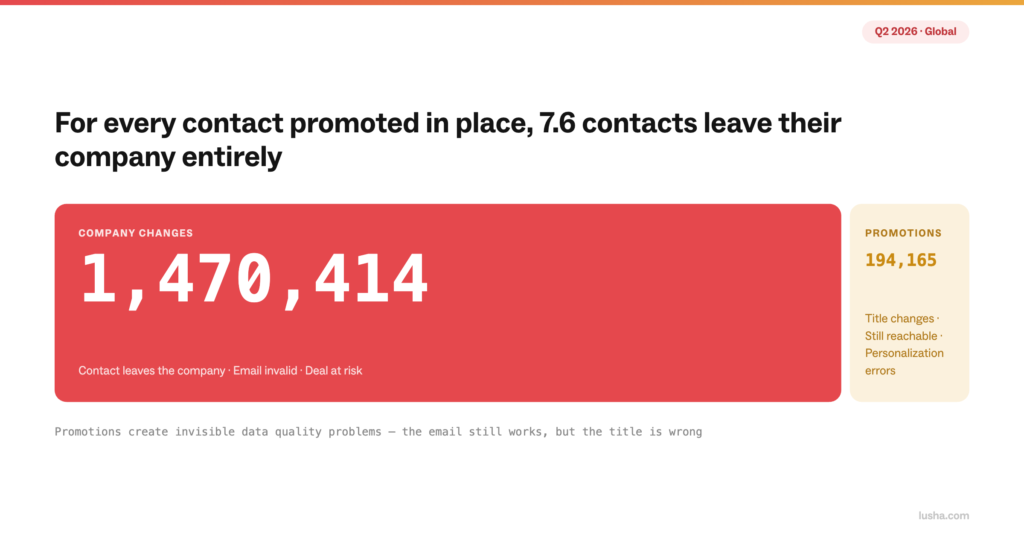
| Company changes (contact moved to a new company) | 1,470,414 |
| Promotions (title change within the same company) | 194,165 |
| C suite and VP level company changes | 23,301 |
| IT department company changes | 60,384 |
| Sales department company changes | 121,238 |
Average company changes per working day: 13,600
Ratio of company changes to promotions: 7.6:1. For every contact promoted in place, 7.6 contacts changed companies entirely.
The busiest function: Sales
121,238 sales contacts changed companies in the window, more than any other function tracked in the database.
Sales mobility is not new. What changes is how long the CRM takes to notice. In many organizations a rep leaves and the record stands until an email bounces, a LinkedIn notification arrives or someone discovers it on a call. By then weeks of outreach have gone somewhere that no longer exists.

What 121,238 changes means for outbound teams
Every sales contact who changes companies creates three problems at once.
Problem 1: the departed contact’s record. Still in the CRM at the old company, still flagged primary, still enrolled in sequences, possibly still on a live deal. The email will fail, the direct dial will be disconnected or reassigned, and the record will say otherwise until someone checks.
Problem 2: the new company opportunity. The person who just moved is often in a buying position at the new employer, assessing an inherited stack and receptive to vendors they used and liked before. That window closes as the new stack gets locked in, typically inside 30 days.
Problem 3: the coverage gap. Every departure leaves a hole in the relationship map at the old account. If that contact was the only relationship there, which is common, the account is unworked until somebody new is identified, verified and engaged.
Which seniority levels are moving
Changes are spread across every seniority level in Sales, with the commercially significant concentration at director and head of level: the people who run regions, manage AE teams and carry relationships that survive renewals.
VP level and above show the lowest raw counts and the highest impact per change. A VP of Sales who moves takes a strategic vendor relationship with them, not a single account.
IT: 60,384 changes in the highest value buying function
For B2B technology vendors the IT function is the critical contact pool. CIOs, CTOs, CISOs, heads of IT and VPs of infrastructure are the economic buyers and technical evaluators on enterprise software purchases.
60,384 IT contacts changed companies in the window, and the count understates the risk, because IT leader changes carry disproportionate deal impact. When a CIO moves, the new employer’s evaluation often restarts from nothing and the previous employer’s selection, perhaps months in, loses its internal champion.
The title distribution reflects a widening function. CIO and CTO moves remain the commonest, and the fastest growing categories are security leadership and data and AI leadership: chief data officer, chief AI officer, chief digital officer. The newest senior titles in technology, and the ones with the fiercest competition for people.
C suite mobility: 23,301 moves at the top
23,301 contacts at C suite and VP level changed companies. At 1.6% of all changes this is not the largest segment by volume, and it is the one with the largest consequences.
A C suite departure from an account in an active pipeline creates four problems at once.
Deal risk at the current account. If the person leaving was the economic buyer or the champion, the deal is at risk of stalling or restarting. Whoever arrives will review the decision their predecessor was about to make, and may not share the appetite for it.
New opportunity at the new company. An executive joining a new organization typically reviews the inherited vendor stack in the first 60 to 90 days. A vendor who reaches out before that review starts is in a different position from one who waits for an inbound.
CRM contamination. The departed executive’s record stays active, often as primary contact on several accounts. Every automated touch, renewal reminder and campaign referencing that contact goes to an address nobody reads.
Relationship map disruption. In many enterprise accounts the C suite contact was the entry point for everything else. When they leave, the selling organization often has no other active contact there, and discovering that mid deal is the expensive version of this problem.

Promotions: the silent data quality problem
194,165 contacts were promoted, a title change inside the same company. Unlike a departure, a promotion does not break the email address or the phone number. The contact is still reachable. What breaks is personalization, routing and scoring.
Personalization errors. A sequence written for “someone managing the sales team” landing with a contact who is now CRO reads as no research at all. It reaches the right inbox and signals the wrong thing.
Scoring errors. A contact scored Grade B at director level may be a Grade A at VP or C suite. If the score is not updated, they are ranked below accounts that deserve less attention, or excluded from senior campaigns entirely.
Routing errors. Many organizations route by seniority: enterprise reps above VP, commercial reps below. A promoted contact who was never rerouted is worked by the wrong rep for months.
The 7.6:1 ratio
For every contact promoted in place, 7.6 leave their company entirely. Departures are the more common problem by volume. Promotions are the harder one to see, because a departure eventually announces itself through a bounce or a returned call and a promotion never does.

Geographic patterns, and what they do not show
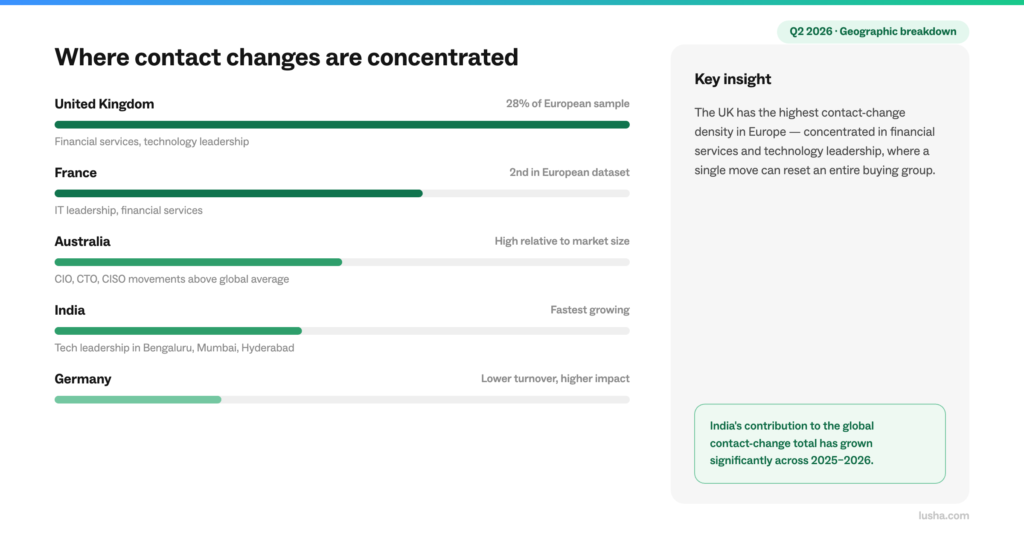
The Q2 2026 data shows a consistent geographic pattern. One caveat first, because it changes how the rest should be read: this dataset was pulled globally without a geographic filter, and the resulting sample skews European. The shares below describe where changes were detected in this sample, not the relative mobility of each market.
The United Kingdom shows the highest contact change density of any single country here, about 28% of detected changes in the European portion. A fluid labor market, a dense concentration of technology and financial services employers and a strong executive recruitment market together produce more turnover than comparable European economies. A separate cohort measurement supports this: UK sales leaders changed roles at 21.7% over twelve months against 12.6% in the US, about 1.7 times the rate. See How fast does B2B contact data decay?
France is second in the European portion, concentrated in IT leadership and financial services.
Australia is high relative to its market size, about 14% of sample contacts with company changes, with notable movement in IT leadership.
India is the fastest growing contact change market in this dataset, with a large and growing senior technology population in Bengaluru, Mumbai and Hyderabad and a competitive executive talent market.
The US appears lower than its market size would suggest, and that is the sampling artifact rather than a finding. It represents a substantial absolute volume of the 1,470,414 total.

What stale data costs
The case for contact hygiene is usually made in bounce rates. Those are real. The larger costs are the ones nobody logs.
Pipeline lost to departed contacts. A deal whose champion leaves mid cycle is far less likely to close than one where the champion stays. Few CRMs flag the departure, so the rep discovers it through a meeting that does not happen or a third voicemail.
Sequences spent on invalid contacts. A sequence running against a list with 15% stale records sends 15% of its messages nowhere. Those bounces accumulate as domain damage and reduce deliverability for everything sent afterwards.
Opportunities missed. The 121,238 sales contacts who changed companies are 121,238 people who arrived somewhere new inside an evaluation window. For a vendor who detects the move, that is a warm opening. For one whose data is stale, it never happened.
How often contact data should be refreshed
The cadence below uses Lusha’s measured decay rate rather than the 30% annual figure this category repeats. We went looking for a primary source for that 30% and could not find one; measured against 148,000 records, the rate for US sales leaders is 12.6% a year, or about 1% a month. The full measurement, rerun in September 2026, is published here.
At about 1% a month, a team holding 1,000 contacts on active deals or in live sequences should expect roughly 31 of them to become wrong each quarter. That is about one every other working day, at team level, before anyone notices.
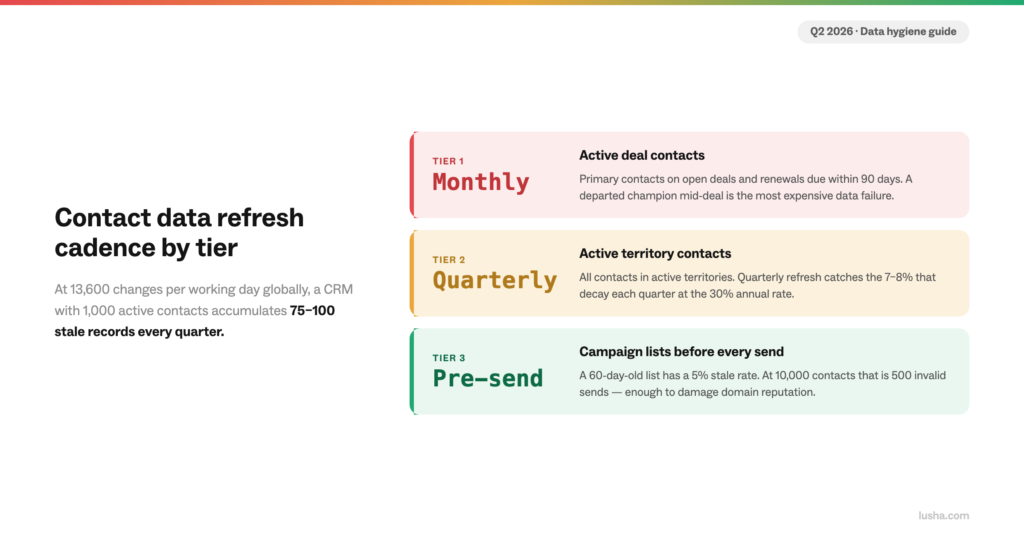
Tier 1, active deal contacts: validate monthly. The cost of discovering a departed champion mid deal is high enough that monthly checking pays for itself even on a small book.
Tier 2, territory contacts: validate quarterly, adjusted by region. A quarterly refresh catches roughly 3% of a US list. A UK list moves about 1.7 times faster, so the same cadence leaves it in worse shape at every point in the cycle.
Tier 3, campaign lists: validate before every send. A list that was accurate 60 days ago is about 2% wrong. At 10,000 contacts that is roughly 200 invalid sends, and bounces at that rate accumulate against the sending domain.
One caution that applies to all three. Our three month measurement returned half the monthly rate of the longer windows, which is detection lag rather than a real slowdown: the newest changes are the ones least likely to have surfaced anywhere yet. A recent refresh date is weaker evidence than it looks, which is why the campaign tier is at send time rather than on a schedule.

What to do with this data
For sales reps and CSMs: check the signal on any contact on an active deal or renewal before reaching out. A 30 second check before a call prevents finding out about a departure on the first ring. The validate call attendees play does it for every meeting on the calendar.
For RevOps and sales managers: run a departure scan on primary contacts in active deals each week. The dark accounts scan play surfaces every account where the main contact has gone dark or left. The quarterly contact change log play builds the record for territory reviews.
For marketing ops: validate every list before a send. The validate emails before campaign play removes bounces, updates titles and flags departures before anything leaves the platform.
For any team: those 121,238 sales contacts are an outreach opportunity, not only a data quality problem. The find people who just changed roles play finds them at their new companies and drafts the outreach before the window closes.
Run these live: add the Lusha plugin to Claude →
Methodology and data notes
Data source: Lusha’s live signal database, queried June 1, 2026. All counts reflect contacts with at least one qualifying event detected between January 1 and June 1, 2026.
Signal definitions:
- Company change: contact detected at a new company domain with a new role, distinct from the prior employment record.
- Promotion: contact detected with a new title at the same company, at a higher seniority classification than the prior title.
Geographic note: the breakdown uses Lusha’s contact location field, which reflects where the contact is rather than where the employer is headquartered. A CIO based in London working for a French company appears as UK here. The sample was pulled without a geographic filter and skews European, so the shares describe detection in this sample rather than relative market mobility.
Department classification: Lusha’s department taxonomy. Sales includes account executives, sales directors, heads of sales and VP and C suite sales leadership. Information Technology includes technology leadership and practitioner roles.
Decay rate: the refresh cadence in this report uses the measured rate from our decay study, 12.6% a year for US sales leaders and 25.7% at 24 months, rather than the widely repeated 30% annual figure, for which we could not find a primary source.
What this cannot tell you: only detected changes are counted, so every figure is a floor rather than a ceiling. Title changes that do not cross a seniority threshold, phone reassignments and email migrations are not included, so the rate at which records become wrong in some way is higher than the counts here.
Contact level data: this report presents aggregate trends and signal volumes. No individual contact names or employers are disclosed. Signal data is used to identify market patterns, not to make claims about specific individuals.
Compliance: all data accessed under Lusha’s certified compliance framework. Current certifications are listed on the trust center.
Data pulled from Lusha’s live database. Contact change and promotion signals are time sensitive; run a live query for the current state of any function, geography or seniority level. The windows shown reflect Q1 to Q2 2026 only, and the rate of change is ongoing.
Related resources
- How fast B2B contact data decays, and what it costs: every report on this, in one place
- How fast does B2B contact data decay?: the measured rate behind the cadence above
- B2B Contact Mobility Report: the same moves mapped by function and commercial risk
- Browse the full Lusha plays library